-
Q. Baby's Growth and Development
It is normal for your baby's weight to drop after birth as his/her body loses the excess fluid he/she took in while he/she was bathed in amniotic fluid in your womb. Around one week after birth, your baby's body weight should start to increase. Around two weeks after birth, your baby will recover to his/her birth weight. In the first three months, if your baby is gaining more than 120g weekly, you can be sure that he/she is having enough milk. You may refer to the Health Booklet for the growth charts for weight, height and head circumference for age.

What does the percentile on the growth charts mean?
The percentile for each measurement item indicates how your child's measurement compares with others in the same age-group for that measurement item. For example, if the height percentile for your child's measurement is shown as 75% - this indicates that your child is as tall as or taller than 75% of children in the same age-group, whereas if the height percentile is shown as 10% - this indicates that your child is as tall as or taller than only 10% of children in the same age-group. The same applies for the percentiles for the weight or head circumference.
As children grow, the physical growth of height, weight and organs occur. They develop changes, progression and maturation of vision, auditory sense, motor skill development, cognition, speech, communication, emotion, social adaptation etc. When the children are growing physically, their nerves and intelligence are also developing at the same time, which reflects in behavioral and emotional aspects like cognition, speed, motor skills, and social adaptability; developmental milestones are established. When the development of a child is delaying in one or more milestones, it is called developmental delay.
https://www.healthxchange.sg/children/baby-0-24-months/baby-development-milestones-1-6-months
https://www.healthxchange.sg/children/baby-0-24-months/baby-development-milestones-7-12-months
If my child is not meeting the milestone, what should I do?You should seek the advice of your healthcare professionals during the scheduled developmental assessment of your child.
Reference: BabyCentre UK; HealthHub
-
Q. Baby Feeding: Bottle Feeding Technique
- Hold your baby close to you, holding him or her gently but firmly. It's better for him or her to be on a slight incline so any air bubbles rise to the top, making burping easier. Put the teat against your baby's lips. He or she will open his or her mouth and start to suck. Wait for your baby to open his or her mouth before putting the teat in your baby's mouth. Never force the teat into your baby's mouth.
- When feeding, keep the neck of the bottle at an angle so it's filled with breastmilk or formula. When your baby stops sucking strongly or when he or she has drunk about half the breastmilk or formula, gently remove the bottle and see whether he wants to burp. Once you've tried burping your baby, you can offer the bottle again.
- Observe the cues your baby gives so you can better understand your baby's body language. For example, noticing how your baby moves when he or she's distressed helps you get to know what makes him or her upset or uncomfortable. If your baby goes to sleep while feeding, put him or her over your shoulder, rub his or her back, and stroke his or her head, legs and tummy to wake him or her up. A nappy change is a good way to wake her up if that doesn't work. If your baby doesn't want to finish the bottle don't encourage him or her to, because he or she might have had enough. Let him or her decide how much he or she wants.
- Find a teat that suits your baby with milk flowing slowly, and allowing him or her to take the entire teat in his or her mouth close to the bottom (screw cap).
- Do not feed your baby when he or she is in a swaddle. You must be able to see your baby's hand, so you can observe if your baby is releasing any stress cues and you should free your baby's hands to allow him or her to participate in feeding.
- Observe signs that indicate your baby is full:
- Closing his or her mouth.
- Slowing down or stop suckling.
- Releasing or spitting out the teat.
- Pushing the bottle away.
- Arching his or her back, turning his or her head away.
- Relaxing his or her body and falling asleep.
If the baby shows above signs of "fullness", you or caregiver should stop feeding. Let your baby decide how much he or she wants to drink.
Reference: Ministry of Social and Family Development
- Hold your baby close to you, holding him or her gently but firmly. It's better for him or her to be on a slight incline so any air bubbles rise to the top, making burping easier. Put the teat against your baby's lips. He or she will open his or her mouth and start to suck. Wait for your baby to open his or her mouth before putting the teat in your baby's mouth. Never force the teat into your baby's mouth.
-
Q. Baby Feeding: Burping Techniques
Upright: Rest your baby's head on your shoulder, always be cautious not to press your baby's mouth and nose. Curl one of your palms slightly and place it on the back of your baby, pat gently from bottom to top to help release the gas.
Sitting on your lap: Lean your baby slightly forward and sit him or her on your lap. Gently support your baby's chin and jaw with your fingers. The palm of the other hand should curl slightly to pat or rub from the bottom to the top of your baby's back.
Your little one is still learning how to swallow properly and his or her newborn digestive system is still developing. Your baby may experience a bloated belly after feeding, this can be a sign that your baby has swallowed too much gas during the feeding. Your baby might also be irritable and cry more than usual because of the discomfort in his tummy. He might pass more wind than normal, and may burp, belch or pass gas excessively. Here's how you can help your baby feel less bloated:
1) Feed your baby in a slightly reclining position. This helps reduce the amount of air he or she swallows.
2) Don't overfeed your little one. Stop feeding him or her if he or she refuses or turns away from the bottle or breast.
3) Burp during and after feeding to avoid the build-up of air in your baby's tummy.Reference: Ministry of Health, HealthHub
-
Q. Baby Feeding: Formula Milk Preparation
- Wash your hands thoroughly with soap and water before preparing the milk formula to reduce the risk of contamination.
- Use fully boiled water for formula preparation. Sterilize milk bottles, teats and utensils.
- Add previously boiled water to the bottle to the required level. It is recommended to use lukewarm water above 40 Celsius, to mix with the milk powder.
- Follow the directions for use on the milk can and add the required number of levels of milk powder to the bottle. Please pay attention to the scoop size before preparing the milk as scoop size varies by different brands. Avoid mixing scoops from different brands. Scoop size may be different for the same brand when there is a new version launched.
- Shake or swirl the bottle gently to dissolve the milk powder completely. If the temperature of milk formula prepared is still high, do not feed the baby directly. You can cool it down by putting the milk bottle in a bowl of cold water, or with running tap water.
- The best temperature of prepared milk formula for your baby to drink is about 40 to 45 Celsius, slightly higher than the body temperature (38 Celsius). Before feeding your baby, check the temperature of the prepared feed by dripping a little onto the inside of your wrist. It should feel lukewarm, not hot. If it still feels hot, cool some more before feeding.
- Never save unfinished feeds. Throw away any feed that has not been consumed within two hours. Never use a microwave to prepare or warm-up milk feeds. Microwaves heat unevenly and may cause 'hot spots' that could scald the infant's mouth.
Reference: World Health Organisation
- Wash your hands thoroughly with soap and water before preparing the milk formula to reduce the risk of contamination.
-
Q. Baby Feeding: How To Switch Formula Milk
- All approved milk formulas sold in Singapore will provide adequate nutrition for your baby and all infant formulas sold in Singapore must comply with the requirements of the Singapore Food Agency's Sale of Food Act.
- If your child is on a special formula, speak to your healthcare professional before making a switch.
- Sample feeding schedule to switch from current formula to new formula
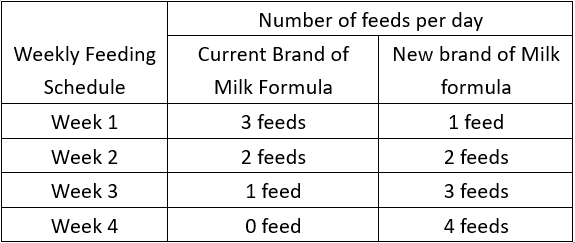
- This feeding schedule is based on a total of 4 feeds per day.
- Kindly refer to the feeding guide on the can label for number of scoops of milk powder required to prepare the required volume of milk & the number of feeds per day.
- Do not switch formulas when your child is unwell.
- After the switch, monitor if your baby has any changes in milk consumption volume, stool color or pattern, to confirm how well your baby has adapted to the new milk formula. If the baby has diarrhea, allergies, or other issues, do stop taking the new formula and speak with your healthcare professional.
Reference: The Straits Times
- All approved milk formulas sold in Singapore will provide adequate nutrition for your baby and all infant formulas sold in Singapore must comply with the requirements of the Singapore Food Agency's Sale of Food Act.
-
Q. Baby Feeding: Is Sugar Bad For Babies?
Sugars and carbohydrates provide the main source of energy for the body and play an important role in the child's development. Common types of sugar include:
- lactose, found in milk and dairy products
- sucrose, a type of sugar extracted from sugar cane or sugar beet
- fructose and glucose, found in fruit, vegetables and honey
- maltose, found in malted drinks and beer
However, not all sugars are born equal.
Lactose is a sugar found in dairy products. It plays a vital role in calcium and phosphorus absorption and supports the growth of good bacteria in the human gut to enhance the development of the immune system. Galactose, a digested product of lactose, plays a vital role in the development of brain and nerve tissues.
On the other hand, sucrose commonly known as table sugar is often added to food and beverages to provide sweetness. Added sugar only provides extra calories to your child's diet, with little other nutritional value. Consuming more calories than he/she can burn through physical activity can lead to undesirable weight gain. Sugary food and drinks also increase the risk of tooth decay, especially if dental hygiene is neglected.
The quality and quantity of sugars consumed are likely to have an impact on the metabolic health and food preferences of a child as well as his/her consumption of sweet, high-energy foods later in life. Today, more children and young adults are developing Type 2 diabetes which occurs when the body does not produce enough insulin or is insulin-resistant, as a result of poor dietary habits. A diet high in sugar increases the risk of diabetes and other health problems.
Recommended sugar limits by age group
This recommendation includes sugar from honey, jam, fruit juice, soft drinks and processed food (such as sweets).
What parents can do:- Be a good role model.
- Ensure that your child has a balanced diet with a variety of food.
- Choosing food and beverages without added sugar to minimize excessive sugar intake for your child.
Reference: HealthHub, Mount Alvernia Hospital
-
Q. Baby's Immunisation
Immunisation is an important way to protect your child from certain life-threatening diseases. All the diseases that your child is protected against are serious diseases and by immunising your child, you are also ensuring better protection for the population.

How Do Vaccines Help?
The idea behind vaccination is to give us immunity to a disease before it has a chance to make us sick.
Vaccines are made from the same virus or bacterium (or parts of them) that cause disease. But in vaccines, they are altered so that they cannot cause illness. These vaccines containing the weakened or killed germs are introduced into our body, usually by injection. Our immune system reacts to the vaccine in the same way as to the disease, by making antibodies. Then they stay in our body, giving us immunity and hence afford protection against those diseases.
This “immunologic memory” lasts longer for some vaccines than for others and sometimes re-vaccination is required to maintain protection. Immunisations therefore help the child's immune system do its work. The child develops protection against future infections, the same as if he or she had been exposed to the natural disease. The good news is, with vaccines your child does not have to get sick first to get that protection.

Immunisation for Diphtheria and Measles are COMPULSORY by law.The National Immunisation Registry (NIR) maintains the immunisation records for all Singapore Residents aged 18 years and below. Parents can view their child's immunisation records at the NIR website. NIR uses SingPass for authentication.
The National Childhood Immunisation Programme has been implemented based on recommendations of the Expert Committee on Immunisation, comprising of senior officials from Ministry of Health, consultant paediatricians and experts in communicable disease control.
There are optional vaccines which are not part of the National Immunisation Schedule. Enquiries about these optional vaccines can be made through your family doctor, polyclinic or specialist.
Side effects
The needle does cause brief pain, so it is normal for your baby to cry a little. Often this is just for a few seconds after the injection. Soreness, a slight redness and even a small lump are common, but this usually resolves on its own.It is also normal for a child to be a little more irritable for a few hours or even a day or so after the injection and there may also be a slight fever (<38°C) that tends to last usually 1–2 days. Your doctor may prescribe a small dose of paracetamol for pain or fever.
When to delay immunization
- When your baby is born prematurely and weighs less than 2 kg.
- When the child is unwell, for example, a high fever, then delay the immunization till the child is better.
- If the child is being assessed for a neurological problem, is being treated for cancer or has any disease that weakens the immune system, discuss this with your child's doctor.
- Speak with your doctor if your child has had a serious reaction to any previous injection or has an allergy to eggs or anything else.
Reference: HealthHub
-
Q. Childhood Illnesses: Colic
- The cause of colic in babies are not exactly clear. Some possible causes include allergies, lactose intolerance, an immature digestive system and differences in the way a baby is fed or comforted.
- Your newborn has been crying incessantly for weeks now, sometimes wailing for more than three hours at a time, and nothing you do seems to be able to soothe his tears.
- This non-stop crying could actually be a sign of colic, a condition characterised by non-stop crying for more than three hours a day, three days a week, over more than three weeks in an otherwise well-fed, healthy baby. The crying usually begins suddenly and for no clear reason.
- Colic usually starts a few weeks after birth and often improves by the time your baby is three months old. The condition is resolved in 90 percent of babies by the time they are nine months old.
How to deal with it?
- Give your baby frequent small feeds and burp him or her after.
- Offer a pacifier as sucking is a soothing activity for babies and may calm them.
- Hold your baby close to you as cuddling may help some babies to quieten and calm down.

- Keep your baby in motion by gently rocking him in your arms or in an infant swing. Alternatively, you may lay your baby tummy down on your knees and then sway your knees slowly or take a walk with your baby
- Sing to your baby to soothe him.
- You may need to seek medical advice if your baby cries persistently and is not feeding and sleeping well or behaving normally.
Take note of the number of times and schedules when your baby cries and record his or her sleeping and eating patterns. Share these notes with the doctor who will likely conduct a physical examination to identify any possible causes for your baby's distress such as an intestinal obstruction. Diagnostic tests are usually not required.
Reference: HealthHub
- The cause of colic in babies are not exactly clear. Some possible causes include allergies, lactose intolerance, an immature digestive system and differences in the way a baby is fed or comforted.
-
Q. Childhood Illnesses: Diarrhea and Vomiting
In newborns, the ring of muscle between the esophagus and the stomach – the lower esophageal sphincter (LES) – is not fully matured. Hence, they will get gastroesophageal reflux easily. When your baby is drinking milk, they may swallow air into his/her stomach. If the air does not clear totally, he/she may spit out some milk when he/she burps or have hiccups. These are the common reasons for milk spills. If your baby spits out yellow, green bile or he/she is not gaining weight, you should speak with your healthcare professional.
Generally, your baby should have one to three bowel movements a day. You should observe the shape, color, smell and amount of the stools to help prevent gastrointestinal disease. Most newborns will have bowel movements while drinking milk. This is a natural reflex called the gastrocolic reflex. Often because the stools are watery, your baby may fart and make bowel movements at the same time, hence increased bowel movements. As long as your baby eats normally, is active and gains weight, there is no need to worry.Treating Children with Diarrhoea at Home
Children less than 12 months old
Breastfed babies: Continue breastfeeding and feed more often.Formula-fed babies:
- Continue feeding your baby with his formula milk.
- If diarrhea persists for more than 10 days, you may consider switching to soy formula or lactose-free formula milk.
- Do not feed your baby water only.
- If your child is persistently vomiting, take him for a doctor's consultation.
Children more than 12 months old
- Stop solids and offer fluids to your child.

- Ensure that your child continues to take sufficient fluids.
- If your child is not vomiting, ensure hydration by increasing his fluid intake. You may use oral rehydration solution like Pedialyte or Hydralyte. These solutions are best served cold and may even be frozen to "ice sticks". Alternatively, you may use rice water or barley water. Fruit juice should be diluted with one cup of fruit juice to four cups of water.
- When the nature and frequency of the stools improve, you can slowly reintroduce your child to normal feeds.
- If your child is vomiting, you can give him a trial of small but frequent clear feeds. For example, you may start with 10ml of fluid every 10 to 15 minutes for one hour. If he can tolerate this, you can increase the volume by 10ml each subsequent hour.
-
If your baby is having the following symptoms, please bring him/her to the doctor as soon as possible:
- Loss of appetite
- Passing watery stools for a couple of times within 1 to 2 hours. Diapers need to be changed multiple times.
- Frequent vomiting
- Fever
- Feeling very thirsty
- Blood is found on diapers
- Abnormal anxiety
- Eye sockets or fontanel sunken with a dry mouth
- Persistent diarrhoea for over 24 hours
Reference: HealthHub
-
Q. Childhood Illnesses: Fever
A normal, healthy person has a body temperature around 37 degrees Celsius. When our body is invaded by virus or bacteria, the immune system raises our body temperature to fight the infection, resulting in a fever.
A fever can happen suddenly and it may not be easy to pinpoint its cause.
Look out for these illnesses and their accompanying symptoms, which tend to cause fever in children:- Upper Respiratory Tract Infections (Common Cold): sore throat, stuffy nose, cough
- Gastroenteritis (Stomach Flu): vomiting, diarrhea, stomach ache
- Influenza (Flu): headache, chills, muscle aches, general fatigue, cough, sore throat
- Hand, Foot and Mouth Disease: blister-like rash on the palms, soles, buttocks, tongue and mouth
- Dengue Fever: headache, muscle and joint aches, rash
- Chickenpox: blister-like rash on the body
- Kawasaki Disease: red eye, body rash, swollen lips, tongue, feet, hands, lymph nodes in the neck
A recent vaccination may bring about a low-grade fever, but teething in babies usually does not cause fever.
Measuring the body temperature
Choose a thermometer that is easy to use depending on the age of your child:
- Digital thermometers (for ears, temple, forehead): These are non-invasive and easy to use on young children, even when they are asleep.
- Digital oral thermometers: Your child needs to be able to keep still and hold the thermometer in his mouth long enough to take a reading. A digital oral thermometer is relatively cheap and easy to use, and provides accurate readings. Do note that a reading taken under the armpits is less accurate.
- Rectal thermometer: This gives the most accurate reading but is invasive and less convenient to use.
- Do not use a mercury thermometer for children under six in case of breakage leading to mercury poisoning.
A temperature between 37.5 to 37.9 degrees Celsius is a low-grade fever, and a temperature above 38.5 degrees Celsius is high fever.
To help your child feel more comfortable, here's what you can do to bring down his temperature:- Sponge him with lukewarm water. Do not sponge your child with ice water or cold water, or for more than 30 minutes at a time.
- Dress your child in thin clothing and cool the room. Do not wrap him in thick blankets to “sweat it out” as it will prevent him from losing heat.
- Let your child rest more and drink lots of fluids to avoid dehydration.
- Seek medical advice and take the prescribed dosage of fever medication like paracetamol and ibuprofen (provided your child has no allergies) if his fever remains above 38.5 degrees Celsius. Do not give your child aspirin.
When Should You Bring Your Child to the Doctor?
Fever can be scary, especially if your child is very young, or if his fever is persistently high for a few days. Very high fever in children may cause febrile fits but rarely do high fever and febrile fits lead to brain damage.A higher temperature does not mean a more severe illness. Fever is a symptom of an underlying disease and a sign that the body is fighting the disease.
Depending on your child's age, look out for changes in his behaviour when deciding whether and when, to bring him to the doctor.
If your child appears well and is able to take feeds or eat despite running a fever, let him rest and sponge him to keep his temperature below 38 degrees Celsius.However, if your child has a fever and shows the following signs, bring him to the doctor:
- Not eating well or unable to keep food down due to vomiting
- Has difficulty breathing
- Is lethargic and drowsy
- Looks sicker than previously
- Has abdominal pain and discomfort
- Has a rash
- Is dehydrated (e.g. not passing enough urine)
You should also bring your child to the doctor if:
- your baby is below three months old and has a fever above 38 degrees celsius
- your baby is below one year old and has a fever for more than 24 hours, or has a high fever
- your child is above one year old and has a high fever for more than three days
Reference: HealthHub